Styllo - Agentic Wardrobe Assistant
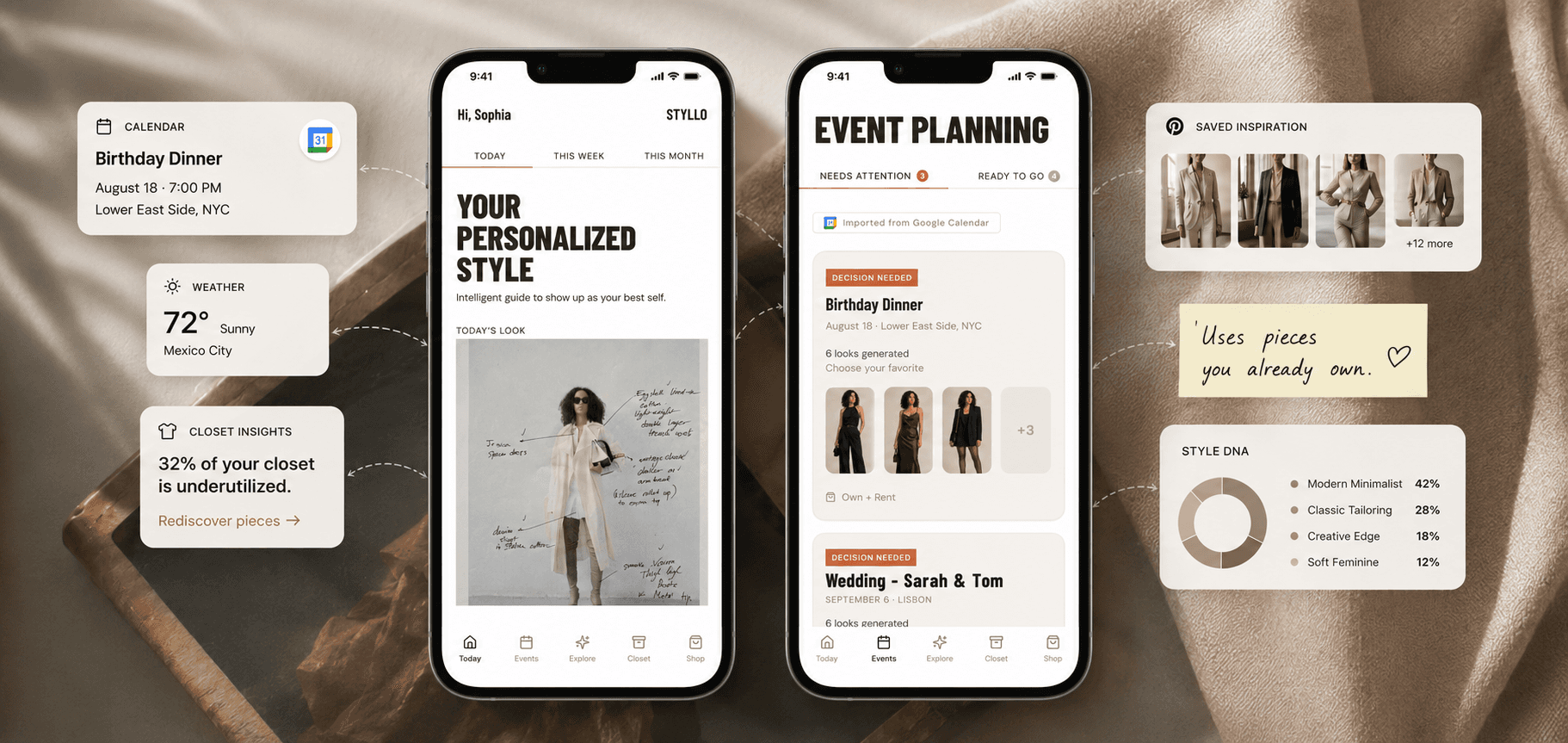
As part of USC's MSIDBT Fashion & Technology Practicum, I explored how emerging AI technology could transform fashion commerce. Styllo is an agentic personal styling platform that understands your wardrobe, calendar, lifestyle, and personal style to proactively decide what you should wear.
Instead of optimizing for purchases, it maximizes wardrobe utility, encouraging outfit reuse, rentals, secondhand shopping, and only recommending purchases when they genuinely improve your wardrobe.

01
PROJECT OVERVIEW
Fashion technology isn't designed to help people wear their clothes. It's designed to to have them buy more.
Styllo helps them make better decisions.
While most shopping experiences optimize for clicks, conversions, and product discovery, Styllo strives to makes intelligent wardrobe decisions for you.
Styllo is an agentic personal stylist that understands your wardrobe, schedule, lifestyle, and long-term style goals to to recommend what to wear before you ever think about shopping. Because the smartest purchase is often not making one.
One where AI agents understand a user's identity, wardrobe, lifestyle, preferences, and upcoming life events to help auto generate make more intentional decisions about what they wear and buy.
My Role
As part of USC's MSIDBT Fashion & Technology Practicum, I led the project from concept through high-fidelity prototype, defining both the product vision and interaction model.
Styllo - Proof of Concept
02
APPROACH & USER RESEARCH
Starting with a hypothesis
I believed people didn't actually need another shopping app.
I wanted to understand why, despite overflowing closets and endless inspiration, getting dressed still felt difficult.
Through exploratory interviews with USC students, conversations with young professionals in Los Angeles, and market research across AI, fashion, resale, and rental platforms, I looked for patterns in how people actually make wardrobe decisions.
15 interviews
Ages 20 - 32
LA / Remote
01
Insight
Shopping has become emotionally exhausting.
Closets are full. Decision confidence is low.

So much to choose from ->
And still, nothing to wear.
02
Insight
AI should guide —
not dictate.
People were excited about AI's potential, but hesitant to hand over their personal style to an algorithm.
"I don't want AI deciding my style, I want it helping me think".
Interview Participant, Age 27
03
Insight
Style is
identity
Interviewees describes themselves through aesthetics, not fashion categories.
Creative director
CLEAN GIRL
Scandi Minimalist
Boho Chic
GORPCORE
Preppy
Y2K Revival
03
Reframing The ProbleM
I realized I wasn't designing an AI stylist. I was designing a decision-making system.
Research revealed that users weren't looking for more recommendations, they were looking for more confidence in their purchases. This shifted the project away from shopping and toward decision support.
THE INTELLIGENCE LAYER
Four connected layers of agents drive every decision Styllo helps you make with the help of of APIs.
01
Taste
AI Agent

Signals from:
Pinterest boards
Instagram Saves
LTK likes
Moodboards
Initial onboarding quiz
Explicit likes & skips
Builds:
Dynamic Style DNA
Learns what inspires you, not just what you purchase.
02
Contextual
AI Agent

Signals from:
Google Calendar
Travel plans
Weather updates
AI conversations
Personal goals
Custom event prompts
Builds:
Smarter Wardrobe Decisions
Wear more. Buy better.
03
Closet & Inventory AI Agent

Signals from:
Uploaded wardrobe
Categories
Colors & brands
Wear frequency
Outfit history
Fit notes
Builds:
Context-Aware Style Briefs
Recommendations adapt to your life, not the other way around.
04
History
AI Agent

Signals from:
Daily outfit check-ins
Confidence & comfort
Compliments received
Repeat wear
Outfit uploads
Purchase satisfaction
Builds:
Behavioral
Memory
Every interaction makes future recommendations smarter.
04
Designing for everyday Decisions
A day with Styllo.
Once the intelligence layer was established, I focused on designing experiences that felt less like using an app—and more like having a thoughtful stylist who quietly understood your life.
DAILY STYLE BRIEF
Know what to wear before you think about it.

EVENT PLANNING
The more context you provide, the smarter the recommendations.

DECISION INTELLIGENCE
Wear what you own. Buy only what earns its place.

05
Exploring What's next
Content
Content
Content
Styllo is just the beginning.
The first version focused on helping people make better wardrobe decisions. As I continued exploring the concept, I began imagining how the platform could evolve beyond styling—into a more connected, sustainable, and deeply personal system.
Community Circulation
Style is better when it circulates.
Borrow from friends or neighbors
Community wardrobe networks
Sustainable by default

Style
Memory
Your clothes. Your chapters
Save meaningful outfit moments
Revisit favorite looks
Visual style evolution over time

Behavioral
Intelligence
Learn why, not just what.
Detect confidence patterns
Learn from repeat wear
Suggest outfits before users ask

Similarity
Intelligence
Recommendations from people like you.
Similar body types
Shared aesthetics
Comparable lifestyles

08
BEYOND THE CLASSROOM
From Concept → Conversation
I presented Styllo at the USC IBDT Think Tank, sharing the concept with faculty, startup founders, and industry professionals as part of USC's graduate showcase.
The conversations that followed reinforced something I hadn't expected:
AI wasn't the interesting part—helping people feel understood was.

Graduate Showcase Presentation
Presented Styllo to faculty, founders, and industry professionals, receiving feedback on both the product vision and long-term business potential.
Feedback
Themes
AI that felt practical, not gimmicky
Identity-first, confidence-driven personalization
Strong systems thinking across UX, AI, and business
Clear opportunity for a more human approach to styling
What's
Next
Build an MVP with real wardrobes
Validate long-term behavior change through user testing
Explore resale and rental partnerships
Expand the styling intelligence engine