Pizza Hut - Store Management System
SHORTER
When Pizza Hut sunset its legacy store management platform, the U.S. business needed a new operational experience without disrupting day-to-day restaurant operations.
Working within an aggressive timeline, I designed foundational workflows that enabled franchise operators to manage store availability, fulfillment, inventory, notifications, and operational controls while extending Maverick, Pizza Hut International's existing design system, with new patterns for U.S. operations.
Impact
6,800+ stores supported
Timeline
2024 - 2026
Role
Senior Product Designer

01
PROJECT OVERVIEW
Building the Operational Backbone for 6,800+ Pizza Hut Restaurants
As Pizza Hut prepared to sunset its legacy store management platform, Quikorder, the U.S. business needed a new operational system capable of supporting thousands of franchise locations.
Working within aggressive timelines, I designed Store Admin, the operational internal tool that allowed stores to adapt to changing business conditions while extending Maverick, the design system used by Pizza 6,800+ stores supportedHut International.
My Role
Instead of recreating the legacy experience screen-for-screen, I partnered across Product, Engineering, and Operations to build a new Store Admin experience using the Maverick design system as foundation.
Incident Management - Before

01
PROJECT OVERVIEW
Building the Operational Backbone for 6,800+ Pizza Hut Restaurants
As Pizza Hut prepared to sunset its legacy store management platform, Quikorder, the U.S. business needed a new operational system capable of supporting thousands of franchise locations.
Working within aggressive timelines, I designed Store Admin, the operational internal tool that allowed stores to adapt to changing business conditions while extending Maverick, the design system used by Pizza 6,800+ stores supportedHut International.
My Role
Instead of recreating the legacy experience screen-for-screen, I partnered across Product, Engineering, and Operations to build a new Store Admin experience using the Maverick design system as foundation.
Deals Page - Before

01
PROJECT OVERVIEW
Building the Operational Backbone for 6,800+ Pizza Hut Restaurants
As Pizza Hut prepared to sunset its legacy store management platform, Quikorder, the U.S. business needed a new operational system capable of supporting thousands of franchise locations.
Working within aggressive timelines, I designed Store Admin, the operational internal tool that allowed stores to adapt to changing business conditions while extending Maverick, the design system used by Pizza 6,800+ stores supportedHut International.
My Role
Instead of recreating the legacy experience screen-for-screen, I partnered across Product, Engineering, and Operations to build a new Store Admin experience using the Maverick design system as foundation.
Deals Page - Before
01
PROJECT OVERVIEW
Building the Operational Backbone for 6,800+ Pizza Hut Restaurants
As Pizza Hut prepared to sunset its legacy store management platform, Quikorder, the U.S. business needed a new operational system capable of supporting thousands of franchise locations.
Working within aggressive timelines, I designed Store Admin, the operational internal tool that allowed stores to adapt to changing business conditions while extending Maverick, the design system used by Pizza 6,800+ stores supportedHut International.
My Role
Instead of recreating the legacy experience screen-for-screen, I partnered across Product, Engineering, and Operations to build a new Store Admin experience using the Maverick design system as foundation.
Incident Management - Before
02
APPROACH & USER RESEARCH
Designing for operational reality.
Operations Are Messy
Restaurants constantly adjust to staffing shortages, promotions, inventory constraints, and local conditions.
??

??
??
??
02
APPROACH & USER RESEARCH
Designing for operational reality.
Heuristic Evaluations
Operations Are Messy
Restaurants constantly adjust to staffing shortages, promotions, inventory constraints, and local conditions.
Usability Studies
Edge cases are the product in operations
Split hours, temporary closures, neighborhood delivery restrictions, and payment limitations weren't exceptions, they were everyday operational needs.
CRO & Behavioral Analytics
Visibility Creates Confidence
Managers needed to quickly understand what changed, who changed it, and whether action was required.
??
Everything competes equally for attention.
Pricing lacks hierarchy; no anchor for value comparison
Promotions blended together visually
Deals Page


What’s included?
How does this deal compare to others?
Deal Builder

Comparing deals required memory
Users had to open each builder to understand what’s included
02
APPROACH & USER RESEARCH
Designing for operational reality.
Heuristic Evaluations
Operations Are Messy
Restaurants constantly adjust to staffing shortages, promotions, inventory constraints, and local conditions.
Usability Studies
Edge cases are the product in operations
Split hours, temporary closures, neighborhood delivery restrictions, and payment limitations weren't exceptions, they were everyday operational needs.
CRO & Behavioral Analytics
Visibility Creates Confidence
Managers needed to quickly understand what changed, who changed it, and whether action was required.
??
Everything competes equally for attention.
Pricing lacks hierarchy; no anchor for value comparison
Promotions blended together visually
Deals Page
What’s included?
Back and forth
repeatedly
Customer taps to open deal
How does this deal compare to others?
Deal Builder
Comparing deals required memory
Users had to open each builder to understand what’s included
03
THE CHALLENGE
Balance speed, flexibility, and consistency.
The project presented three competing constraints:
Replace a business-critical legacy platform without disrupting thousands of stores.
Deliver quickly by leveraging Maverick while expanding it to support entirely new operational workflows.
Build enough flexibility to handle real-world operational complexity without making everyday tasks harder.
This meant solving for dozens of interconnected workflows that all needed to feel like one cohesive product.
Research Findings
03
THE CHALLENGE
Balance speed, flexibility, and consistency.
The project presented three competing constraints:
Replace a business-critical legacy platform without disrupting thousands of stores.
Deliver quickly by leveraging Maverick while expanding it to support entirely new operational workflows.
Build enough flexibility to handle real-world operational complexity without making everyday tasks harder.
This meant solving for dozens of interconnected workflows that all needed to feel like one cohesive product.
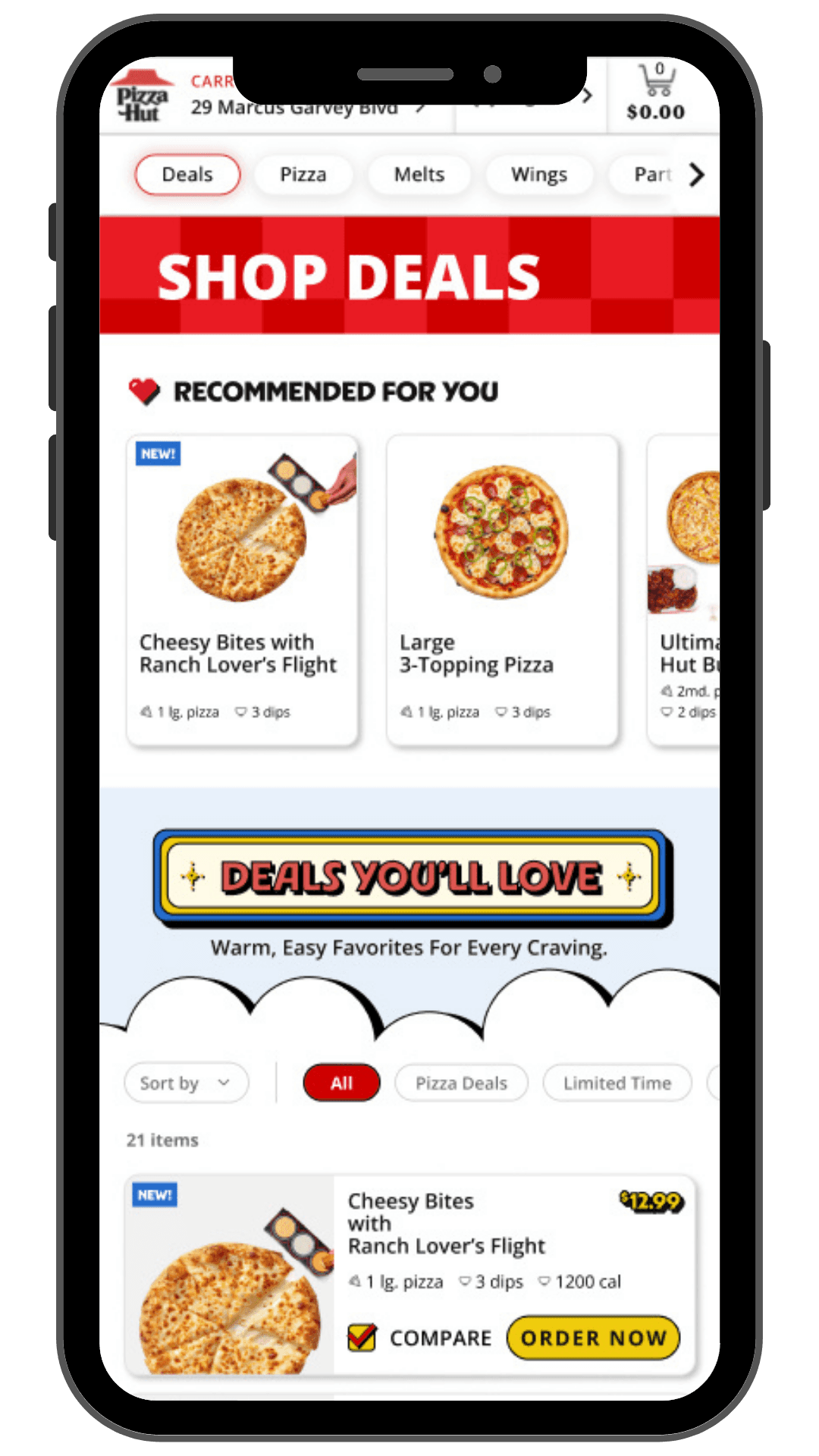
Bento Box

Carousel Prominence

Deal Propensity + Merchandising
03
THE CHALLENGE
Balance speed, flexibility, and consistency.
The project presented three competing constraints:
Replace a business-critical legacy platform without disrupting thousands of stores.
Deliver quickly by leveraging Maverick while expanding it to support entirely new operational workflows.
Build enough flexibility to handle real-world operational complexity without making everyday tasks harder.
This meant solving for dozens of interconnected workflows that all needed to feel like one cohesive product.
Bento Box
Carousel Prominence
Deal Propensity + Merchandising
03
THE CHALLENGE
Balance speed, flexibility, and consistency.
The project presented three competing constraints:
Replace a business-critical legacy platform without disrupting thousands of stores.
Deliver quickly by leveraging Maverick while expanding it to support entirely new operational workflows.
Build enough flexibility to handle real-world operational complexity without making everyday tasks harder.
This meant solving for dozens of interconnected workflows that all needed to feel like one cohesive product.
Research Findings
Project Overview
Approach & Research
Challenge
Execution
Results
Reflection
04
THE PIVOT
I stopped designing features and started designing operational systems.
As new requests continued to come in from franchisees and store operators, it became clear these weren't isolated problems.
They all represented different ways operators needed to control their business.
Instead of creating one-off solutions, I identified reusable interaction patterns that could scale across the platform.
—-> example of the notification hub? we were taking one scenario one by one and just redesigning it under maverick, realized i can use the patterns and leverage but make better

New Design Framework
04
THE PIVOT
I stopped designing features and started designing operational systems.
As new requests continued to come in from franchisees and store operators, it became clear these weren't isolated problems.
They all represented different ways operators needed to control their business.
Instead of creating one-off solutions, I identified reusable interaction patterns that could scale across the platform.
—-> example of the notification hub? we were taking one scenario one by one and just redesigning it under maverick, realized i can use the patterns and leverage but make better
————
These became the foundation for:
Availability Management
Fulfillment Controls
Notification & Audit Patterns
Restriction Frameworks
Bulk Actions
Operational Status Patterns
The result was a more scalable product and a stronger Maverick design system.
—-
To support the U.S. market, I explored multiple approaches for features that didn't exist in the existing design system, balancing real-life complexity with ease of use.
Availability Management
I explored different models for managing store hours, including split schedules, temporary closures, recurring exceptions, and future changes to better support day-to-day operations.
Restriction Management
Stores had limited control over delivery zones, payment methods, and third-party aggregators. I designed a flexible framework that gave operators more control while keeping management centralized and scalable.
Centralized Notification Management
Critical notifications was spread across multiple systems and workflows. I explored several iterations of a centralized notification hub that brought together stock alerts, operational updates, and scheduled changes into a single view.
This exploration expanded Store Admin from a configuration tool into a more flexible platform for managing store operations.
04
THE PIVOT
I stopped designing features and started designing operational systems.
As new requests continued to come in from franchisees and store operators, it became clear these weren't isolated problems.
They all represented different ways operators needed to control their business.
Instead of creating one-off solutions, I identified reusable interaction patterns that could scale across the platform.
—-> example of the notification hub? we were taking one scenario one by one and just redesigning it under maverick, realized i can use the patterns and leverage but make better
New Design Framework
05
EXECUTION
Phase 1: Foundation
Testing Operational Edge Cases
Design decisions were tested with franchisees, store managers, and restaurant employees in realistic scenarios.
Execution
—-
Rather than walking through every feature chronologically, I'd make this section a gallery of hero systems, each with a concise story and visual.
CAROUSEL
—

Do
Show clear progress and what's happening

DoN'T
Avoid indefinite waiting
Operational Flexibility
Store Availability
Designed a flexible scheduling framework supporting adjusted hours, temporary closures, split-hour operations, and recurring exceptions without increasing operational complexity.
Fulfillment Controls
Delivery Restrictions & Aggregator Management
Designed new operational controls allowing stores to temporarily restrict deliveries by address, street, or neighborhood, manage third-party aggregators, and adjust payment methods based on staffing, safety, or business conditions.
Visual: Delivery restriction map + toggles
Operational Awareness
Centralized Notification Hub
Replaced fragmented alerts with a unified operational hub, helping managers quickly identify critical updates while introducing audit history to improve transparency and trust.
Visual: Notification center + change history
Spotlight: Future Ordering Controls
During the $2 Personal Pan Pizza promotion, stores began receiving overwhelming volumes of future orders before shifts had even started.
Working closely with Operations, I designed controls that allowed managers to quickly disable or limit future ordering, giving stores the flexibility to protect capacity without shutting down online ordering entirely.
Placeholder metrics
↓ 42% fulfillment-related support requests
5,800+ stores adopted the control
↓ 18% guest wait times during promotion
+23% operator satisfaction
This became one of the clearest examples of how thoughtful operational tooling can directly support business performance.
Visual: Before/after timeline + future ordering controls
Design System Contributions
Throughout the project, I extended Maverick with reusable operational patterns that continue supporting future Store Admin capabilities.
Patterns introduced included:
Availability
Restrictions
Bulk Actions
Notifications
Audit History
Operational Status
Visual: Pattern library cards
Do
Deliver the right help, in the flow

DoN'T
Avoid context switching
Operational Flexibility
Store Availability
Designed a flexible scheduling framework supporting adjusted hours, temporary closures, split-hour operations, and recurring exceptions without increasing operational complexity.
Fulfillment Controls
Delivery Restrictions & Aggregator Management
Designed new operational controls allowing stores to temporarily restrict deliveries by address, street, or neighborhood, manage third-party aggregators, and adjust payment methods based on staffing, safety, or business conditions.
Visual: Delivery restriction map + toggles
Operational Awareness
Centralized Notification Hub
Replaced fragmented alerts with a unified operational hub, helping managers quickly identify critical updates while introducing audit history to improve transparency and trust.
Visual: Notification center + change history
Spotlight: Future Ordering Controls
During the $2 Personal Pan Pizza promotion, stores began receiving overwhelming volumes of future orders before shifts had even started.
Working closely with Operations, I designed controls that allowed managers to quickly disable or limit future ordering, giving stores the flexibility to protect capacity without shutting down online ordering entirely.
Placeholder metrics
↓ 42% fulfillment-related support requests
5,800+ stores adopted the control
↓ 18% guest wait times during promotion
+23% operator satisfaction
This became one of the clearest examples of how thoughtful operational tooling can directly support business performance.
Visual: Before/after timeline + future ordering controls
Design System Contributions
Throughout the project, I extended Maverick with reusable operational patterns that continue supporting future Store Admin capabilities.
Patterns introduced included:
Availability
Restrictions
Bulk Actions
Notifications
Audit History
Operational Status
Visual: Pattern library cards
Do
Provide relevant, transparent guidance

DoN'T
Avoid generic, low-value suggestions
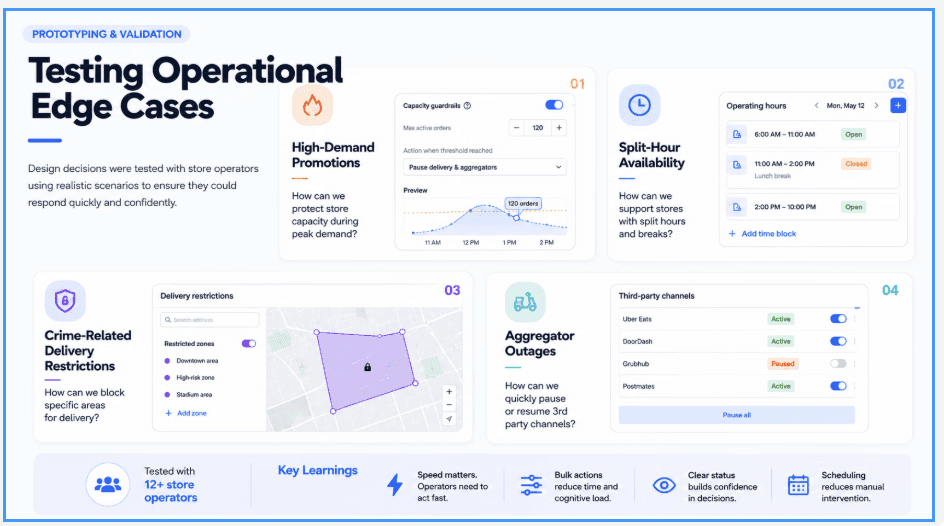
Testing Operational Edge Cases
Design decisions were tested with franchisees, store managers, and restaurant employees in realistic scenarios.
High-demand promotions
How can we protect store capacity?
Lunch break closures
How can we support split-hour stores?
Crime-related delivery restrictions
How can we block specific areas?
Aggregator outages
How can we quickly pause or resume?
Hero story (Future Ordering During a Promotion Surge
During the $2 Personal Pan Pizza promotion, stores began receiving unusually high volumes of future orders before shifts had even started.
Operators had limited ability to control incoming demand.
The Risk
Overwhelmed kitchens
Longer wait times
Poor guest experiences
Operational burnout
The Solution
Designed Future Ordering Controls that allowed operators to:
Enable or disable future ordering
Limit order volume
Protect store capacity
Impact
(Placeholder)
5,800+ stores used controls
40% reduction in fulfillment complaints
18% faster service times during promotion periods
Final Design System Contributions
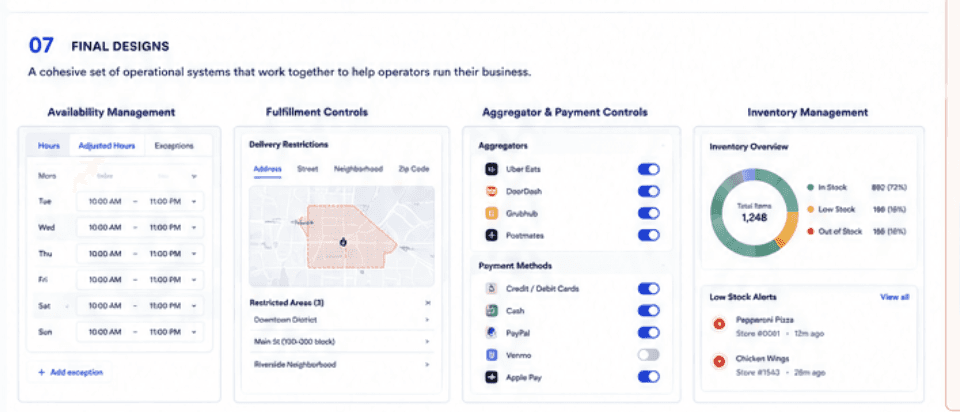
A cohesive set of operational systems that work together to help operators run their business.
Availability Management
Manage operating hours, closures, and scheduling exceptions from a single workflow.
Restriction Management
Control where and how orders are fulfilled based on local business needs.
Aggregator Management
Pause, resume, and monitor third-party ordering channels without support intervention.
Payment Controls
Enable or disable accepted payment methods at the store level as business conditions change.
Inventory Management
Monitor inventory health and quickly identify products that require attention.
Do
Pass context and history to the agent
DoN'T
Avoid starting over
Do
Pass context and history to the agent
DoN'T
Avoid starting over
05
EXECUTION
Phase 1: Foundation
Testing Operational Edge Cases
Design decisions were tested with franchisees, store managers, and restaurant employees in realistic scenarios.
Execution
—-
Rather than walking through every feature chronologically, I'd make this section a gallery of hero systems, each with a concise story and visual.
CAROUSEL
—
Operational Flexibility
Store Availability
Designed a flexible scheduling framework supporting adjusted hours, temporary closures, split-hour operations, and recurring exceptions without increasing operational complexity.
Fulfillment Controls
Delivery Restrictions & Aggregator Management
Designed new operational controls allowing stores to temporarily restrict deliveries by address, street, or neighborhood, manage third-party aggregators, and adjust payment methods based on staffing, safety, or business conditions.
Visual: Delivery restriction map + toggles
Operational Awareness
Centralized Notification Hub
Replaced fragmented alerts with a unified operational hub, helping managers quickly identify critical updates while introducing audit history to improve transparency and trust.
Visual: Notification center + change history
Spotlight: Future Ordering Controls
During the $2 Personal Pan Pizza promotion, stores began receiving overwhelming volumes of future orders before shifts had even started.
Working closely with Operations, I designed controls that allowed managers to quickly disable or limit future ordering, giving stores the flexibility to protect capacity without shutting down online ordering entirely.
Placeholder metrics
↓ 42% fulfillment-related support requests
5,800+ stores adopted the control
↓ 18% guest wait times during promotion
+23% operator satisfaction
This became one of the clearest examples of how thoughtful operational tooling can directly support business performance.
Visual: Before/after timeline + future ordering controls
Design System Contributions
Throughout the project, I extended Maverick with reusable operational patterns that continue supporting future Store Admin capabilities.
Patterns introduced included:
Availability
Restrictions
Bulk Actions
Notifications
Audit History
Operational Status
Visual: Pattern library cards
Testing Operational Edge Cases
Design decisions were tested with franchisees, store managers, and restaurant employees in realistic scenarios.
High-demand promotions
How can we protect store capacity?
Lunch break closures
How can we support split-hour stores?
Crime-related delivery restrictions
How can we block specific areas?
Aggregator outages
How can we quickly pause or resume?
Hero story (Future Ordering During a Promotion Surge
During the $2 Personal Pan Pizza promotion, stores began receiving unusually high volumes of future orders before shifts had even started.
Operators had limited ability to control incoming demand.
The Risk
Overwhelmed kitchens
Longer wait times
Poor guest experiences
Operational burnout
The Solution
Designed Future Ordering Controls that allowed operators to:
Enable or disable future ordering
Limit order volume
Protect store capacity
Impact
(Placeholder)
5,800+ stores used controls
40% reduction in fulfillment complaints
18% faster service times during promotion periods
Final Design System Contributions
A cohesive set of operational systems that work together to help operators run their business.
Availability Management
Manage operating hours, closures, and scheduling exceptions from a single workflow.
Restriction Management
Control where and how orders are fulfilled based on local business needs.
Aggregator Management
Pause, resume, and monitor third-party ordering channels without support intervention.
Payment Controls
Enable or disable accepted payment methods at the store level as business conditions change.
Inventory Management
Monitor inventory health and quickly identify products that require attention.
Winning Variant
A
Featured-first hierarchy

Prioritized high-value offers with clearer hierarchy and deal summaries to improve first-glance comprehension.
B
Discovery-led browsing

Prioritized horizontal exploration and exploratory interaction patterns.
C
High-density comparison

Increased browsing breadth through a denser scanning (double column) layout.
D
Hybrid discovery system
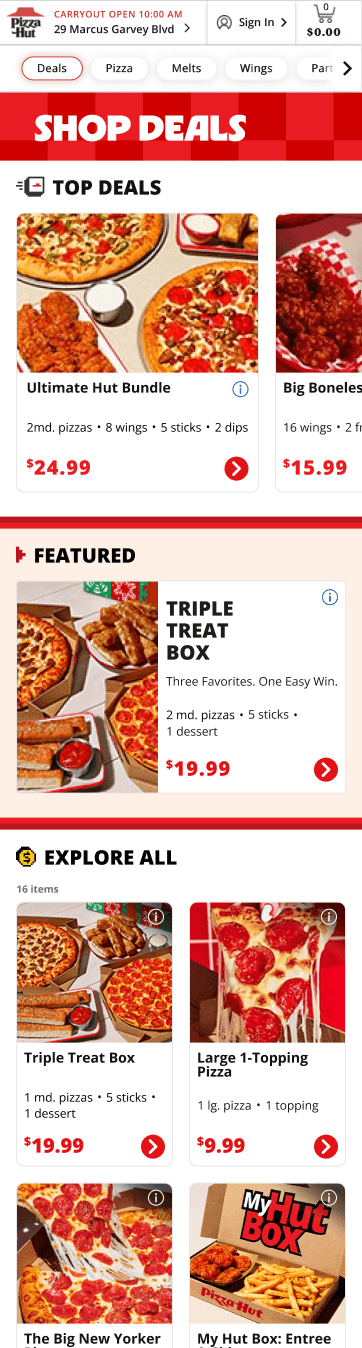
Combined carousel exploration with higher-density browsing behavior.
05
EXECUTION
Phase 1: Foundation
Testing Operational Edge Cases
Design decisions were tested with franchisees, store managers, and restaurant employees in realistic scenarios.
Execution
—-
Rather than walking through every feature chronologically, I'd make this section a gallery of hero systems, each with a concise story and visual.
CAROUSEL
—
Do
Show clear progress and what's happening
DoN'T
Avoid indefinite waiting
Operational Flexibility
Store Availability
Designed a flexible scheduling framework supporting adjusted hours, temporary closures, split-hour operations, and recurring exceptions without increasing operational complexity.
Fulfillment Controls
Delivery Restrictions & Aggregator Management
Designed new operational controls allowing stores to temporarily restrict deliveries by address, street, or neighborhood, manage third-party aggregators, and adjust payment methods based on staffing, safety, or business conditions.
Visual: Delivery restriction map + toggles
Operational Awareness
Centralized Notification Hub
Replaced fragmented alerts with a unified operational hub, helping managers quickly identify critical updates while introducing audit history to improve transparency and trust.
Visual: Notification center + change history
Spotlight: Future Ordering Controls
During the $2 Personal Pan Pizza promotion, stores began receiving overwhelming volumes of future orders before shifts had even started.
Working closely with Operations, I designed controls that allowed managers to quickly disable or limit future ordering, giving stores the flexibility to protect capacity without shutting down online ordering entirely.
Placeholder metrics
↓ 42% fulfillment-related support requests
5,800+ stores adopted the control
↓ 18% guest wait times during promotion
+23% operator satisfaction
This became one of the clearest examples of how thoughtful operational tooling can directly support business performance.
Visual: Before/after timeline + future ordering controls
Design System Contributions
Throughout the project, I extended Maverick with reusable operational patterns that continue supporting future Store Admin capabilities.
Patterns introduced included:
Availability
Restrictions
Bulk Actions
Notifications
Audit History
Operational Status
Visual: Pattern library cards
Do
Deliver the right help, in the flow
DoN'T
Avoid context switching
Operational Flexibility
Store Availability
Designed a flexible scheduling framework supporting adjusted hours, temporary closures, split-hour operations, and recurring exceptions without increasing operational complexity.
Fulfillment Controls
Delivery Restrictions & Aggregator Management
Designed new operational controls allowing stores to temporarily restrict deliveries by address, street, or neighborhood, manage third-party aggregators, and adjust payment methods based on staffing, safety, or business conditions.
Visual: Delivery restriction map + toggles
Operational Awareness
Centralized Notification Hub
Replaced fragmented alerts with a unified operational hub, helping managers quickly identify critical updates while introducing audit history to improve transparency and trust.
Visual: Notification center + change history
Spotlight: Future Ordering Controls
During the $2 Personal Pan Pizza promotion, stores began receiving overwhelming volumes of future orders before shifts had even started.
Working closely with Operations, I designed controls that allowed managers to quickly disable or limit future ordering, giving stores the flexibility to protect capacity without shutting down online ordering entirely.
Placeholder metrics
↓ 42% fulfillment-related support requests
5,800+ stores adopted the control
↓ 18% guest wait times during promotion
+23% operator satisfaction
This became one of the clearest examples of how thoughtful operational tooling can directly support business performance.
Visual: Before/after timeline + future ordering controls
Design System Contributions
Throughout the project, I extended Maverick with reusable operational patterns that continue supporting future Store Admin capabilities.
Patterns introduced included:
Availability
Restrictions
Bulk Actions
Notifications
Audit History
Operational Status
Visual: Pattern library cards
Do
Provide relevant, transparent guidance
DoN'T
Avoid generic, low-value suggestions
Testing Operational Edge Cases
Design decisions were tested with franchisees, store managers, and restaurant employees in realistic scenarios.
High-demand promotions
How can we protect store capacity?
Lunch break closures
How can we support split-hour stores?
Crime-related delivery restrictions
How can we block specific areas?
Aggregator outages
How can we quickly pause or resume?
Hero story (Future Ordering During a Promotion Surge
During the $2 Personal Pan Pizza promotion, stores began receiving unusually high volumes of future orders before shifts had even started.
Operators had limited ability to control incoming demand.
The Risk
Overwhelmed kitchens
Longer wait times
Poor guest experiences
Operational burnout
The Solution
Designed Future Ordering Controls that allowed operators to:
Enable or disable future ordering
Limit order volume
Protect store capacity
Impact
(Placeholder)
5,800+ stores used controls
40% reduction in fulfillment complaints
18% faster service times during promotion periods
Final Design System Contributions
A cohesive set of operational systems that work together to help operators run their business.
Availability Management
Manage operating hours, closures, and scheduling exceptions from a single workflow.
Restriction Management
Control where and how orders are fulfilled based on local business needs.
Aggregator Management
Pause, resume, and monitor third-party ordering channels without support intervention.
Payment Controls
Enable or disable accepted payment methods at the store level as business conditions change.
Inventory Management
Monitor inventory health and quickly identify products that require attention.
Do
Pass context and history to the agent
DoN'T
Avoid starting over
Do
Pass context and history to the agent
DoN'T
Avoid starting over
06
RESULTS
Beyond shipping individual workflows, Store Admin established a scalable operational foundation for Pizza Hut's U.S. business.
Before
After
Business
Supported the transition of 6,800+ restaurants from a legacy platform.
Reduced operational friction during business-critical moments.
Business
Supported the transition of 6,800+ restaurants from a legacy platform.
Reduced operational friction during business-critical moments.
Business
Supported the transition of 6,800+ restaurants from a legacy platform.
Reduced operational friction during business-critical moments.
Business
Supported the transition of 6,800+ restaurants from a legacy platform.
Reduced operational friction during business-critical moments.
Business
Supported the transition of 6,800+ restaurants from a legacy platform.
Reduced operational friction during business-critical moments.
Impact beyond Phase 1
The experiment established an experimentation framework the team could build on. Each following phase introduced one new behavioral hypothesis while preserving what had already been validated.
07
WHAT'S NEXT
One thing this project taught me is that operational software is never truly "finished."
As franchise operations continue to evolve, Store Admin provides a flexible foundation that can support new fulfillment models, AI-assisted operational recommendations, predictive notifications, and more advanced automation without reinventing core workflows.
next: centralized hub, AI personalization
Phase 1 -> Done
Phase 3
Phase 4
Phase 5
08
REFLECTION
The best enterprise products don't eliminate complexity—they make it manageable.
THINGS I BELIEVE NOW
Design for the business, not just the interface.
The most impactful solutions came from understanding how restaurant operational decisions affect staffing, fulfillment, and guest experience - not just the screens where those decisions happened.
Build systems, not one-off features.
Recognizing shared patterns across availability, fulfillment, notifications, and operational controls allowed me to create reusable frameworks that scaled beyond individual workflows and made the Maverick design system stronger.
The best enterprise products make complexity manageable.
Operational complexity will always exist, but software can be designed to give people the clarity and confidence to make better decisions when business conditions change.
02
APPROACH & USER RESEARCH
Designing for operational reality.
Everything competes equally for attention.
Users must open each builder to understand what’s included
Pricing lacks hierarchy; no anchor for value comparison
02
Tap to open deal
02
Back and forth
repeatedly
What’s
included?
Is this actually
a better deal?
How does it compare?
?
Users had to open multiple builders just to answer simple questions.
Operations Are Messy
Restaurants constantly adjust to staffing shortages, promotions, inventory constraints, and local conditions.
Edge cases are the product in operations
Split hours, temporary closures, neighborhood delivery restrictions, and payment limitations weren't exceptions, they were everyday operational needs.
Visibility Creates Confidence
Managers needed to quickly understand what changed, who changed it, and whether action was required.
INITIAL HYPOTHESIS
Body
03
THE CHALLENGE
Balance speed, flexibility, and consistency.
The project presented three competing constraints:
Replace a business-critical legacy platform without disrupting thousands of stores.
Deliver quickly by leveraging Maverick while expanding it to support entirely new operational workflows.
Build enough flexibility to handle real-world operational complexity without making everyday tasks harder.
This meant solving for dozens of interconnected workflows that all needed to feel like one cohesive product.
The concepts generated excitement but not measurable learning.
Each redesign introduced too many variants to test.
Impossible to isolate what actually drives results.
THE REFRAME
Body
Large Hero
Bento
Carousel
Deal Propensity
04
THE PIVOT
I stopped designing features and started designing operational systems.
As new requests continued to come in from franchisees and store operators, it became clear these weren't isolated problems.
They all represented different ways operators needed to control their business.
Instead of creating one-off solutions, I identified reusable interaction patterns that could scale across the platform.
—-> example of the notification hub? we were taking one scenario one by one and just redesigning it under maverick, realized i can use the patterns and leverage but make better
————
These became the foundation for:
Availability Management
Fulfillment Controls
Notification & Audit Patterns
Restriction Frameworks
Bulk Actions
Operational Status Patterns
The result was a more scalable product and a stronger Maverick design system.
—-
To support the U.S. market, I explored multiple approaches for features that didn't exist in the existing design system, balancing real-life complexity with ease of use.
Availability Management
I explored different models for managing store hours, including split schedules, temporary closures, recurring exceptions, and future changes to better support day-to-day operations.
Restriction Management
Stores had limited control over delivery zones, payment methods, and third-party aggregators. I designed a flexible framework that gave operators more control while keeping management centralized and scalable.
Centralized Notification Management
Critical notifications was spread across multiple systems and workflows. I explored several iterations of a centralized notification hub that brought together stock alerts, operational updates, and scheduled changes into a single view.
This exploration expanded Store Admin from a configuration tool into a more flexible platform for managing store operations.
Title
05
EXECUTION
Phase 1: Foundation
Testing Operational Edge Cases
Design decisions were tested with franchisees, store managers, and restaurant employees in realistic scenarios.
Execution
—-
Rather than walking through every feature chronologically, I'd make this section a gallery of hero systems, each with a concise story and visual.
CAROUSEL
—
Winning Variant
A
Featured-first hierarchy
Prioritized high-value offers with clearer hierarchy and deal summaries to improve first-glance comprehension.
B
Discovery-led browsing
Prioritized horizontal exploration and exploratory interaction patterns.
C
High-density comparison
Increased browsing breadth through a denser scanning (double column) layout.
D
Hybrid discovery system
Combined carousel exploration with higher-density browsing behavior.
Operational Flexibility
Store Availability
Designed a flexible scheduling framework supporting adjusted hours, temporary closures, split-hour operations, and recurring exceptions without increasing operational complexity.
Fulfillment Controls
Delivery Restrictions & Aggregator Management
Designed new operational controls allowing stores to temporarily restrict deliveries by address, street, or neighborhood, manage third-party aggregators, and adjust payment methods based on staffing, safety, or business conditions.
Visual: Delivery restriction map + toggles
Operational Awareness
Centralized Notification Hub
Replaced fragmented alerts with a unified operational hub, helping managers quickly identify critical updates while introducing audit history to improve transparency and trust.
Visual: Notification center + change history
Spotlight: Future Ordering Controls
During the $2 Personal Pan Pizza promotion, stores began receiving overwhelming volumes of future orders before shifts had even started.
Working closely with Operations, I designed controls that allowed managers to quickly disable or limit future ordering, giving stores the flexibility to protect capacity without shutting down online ordering entirely.
Placeholder metrics
↓ 42% fulfillment-related support requests
5,800+ stores adopted the control
↓ 18% guest wait times during promotion
+23% operator satisfaction
This became one of the clearest examples of how thoughtful operational tooling can directly support business performance.
Visual: Before/after timeline + future ordering controls
Design System Contributions
Throughout the project, I extended Maverick with reusable operational patterns that continue supporting future Store Admin capabilities.
Patterns introduced included:
Availability
Restrictions
Bulk Actions
Notifications
Audit History
Operational Status
Visual: Pattern library cards
Testing Operational Edge Cases
Design decisions were tested with franchisees, store managers, and restaurant employees in realistic scenarios.
High-demand promotions
How can we protect store capacity?
Lunch break closures
How can we support split-hour stores?
Crime-related delivery restrictions
How can we block specific areas?
Aggregator outages
How can we quickly pause or resume?
Hero story (Future Ordering During a Promotion Surge
During the $2 Personal Pan Pizza promotion, stores began receiving unusually high volumes of future orders before shifts had even started.
Operators had limited ability to control incoming demand.
The Risk
Overwhelmed kitchens
Longer wait times
Poor guest experiences
Operational burnout
The Solution
Designed Future Ordering Controls that allowed operators to:
Enable or disable future ordering
Limit order volume
Protect store capacity
Impact
(Placeholder)
5,800+ stores used controls
40% reduction in fulfillment complaints
18% faster service times during promotion periods
Final Design System Contributions
A cohesive set of operational systems that work together to help operators run their business.
Availability Management
Manage operating hours, closures, and scheduling exceptions from a single workflow.
Restriction Management
Control where and how orders are fulfilled based on local business needs.
Aggregator Management
Pause, resume, and monitor third-party ordering channels without support intervention.
Payment Controls
Enable or disable accepted payment methods at the store level as business conditions change.
Inventory Management
Monitor inventory health and quickly identify products that require attention.
One thing this project taught me is that operational software is never truly "finished."
As franchise operations continue to evolve, Store Admin provides a flexible foundation that can support new fulfillment models, AI-assisted operational recommendations, predictive notifications, and more advanced automation without reinventing core workflows.
next: centralized hub, AI personalization
Winning Variant
A
Featured-first hierarchy
Prioritized high-value offers with clearer hierarchy and deal summaries to improve first-glance comprehension.
B
Discovery-led browsing
Prioritized horizontal exploration and exploratory interaction patterns.
C
High-density comparison
Increased browsing breadth through a denser scanning (double column) layout.
D
Hybrid discovery system
Combined carousel exploration with higher-density browsing behavior.
Operational Flexibility
Store Availability
Designed a flexible scheduling framework supporting adjusted hours, temporary closures, split-hour operations, and recurring exceptions without increasing operational complexity.
Fulfillment Controls
Delivery Restrictions & Aggregator Management
Designed new operational controls allowing stores to temporarily restrict deliveries by address, street, or neighborhood, manage third-party aggregators, and adjust payment methods based on staffing, safety, or business conditions.
Visual: Delivery restriction map + toggles
Operational Awareness
Centralized Notification Hub
Replaced fragmented alerts with a unified operational hub, helping managers quickly identify critical updates while introducing audit history to improve transparency and trust.
Visual: Notification center + change history
Spotlight: Future Ordering Controls
During the $2 Personal Pan Pizza promotion, stores began receiving overwhelming volumes of future orders before shifts had even started.
Working closely with Operations, I designed controls that allowed managers to quickly disable or limit future ordering, giving stores the flexibility to protect capacity without shutting down online ordering entirely.
Placeholder metrics
↓ 42% fulfillment-related support requests
5,800+ stores adopted the control
↓ 18% guest wait times during promotion
+23% operator satisfaction
This became one of the clearest examples of how thoughtful operational tooling can directly support business performance.
Visual: Before/after timeline + future ordering controls
Design System Contributions
Throughout the project, I extended Maverick with reusable operational patterns that continue supporting future Store Admin capabilities.
Patterns introduced included:
Availability
Restrictions
Bulk Actions
Notifications
Audit History
Operational Status
Visual: Pattern library cards
Testing Operational Edge Cases
Design decisions were tested with franchisees, store managers, and restaurant employees in realistic scenarios.
High-demand promotions
How can we protect store capacity?
Lunch break closures
How can we support split-hour stores?
Crime-related delivery restrictions
How can we block specific areas?
Aggregator outages
How can we quickly pause or resume?
Hero story (Future Ordering During a Promotion Surge
During the $2 Personal Pan Pizza promotion, stores began receiving unusually high volumes of future orders before shifts had even started.
Operators had limited ability to control incoming demand.
The Risk
Overwhelmed kitchens
Longer wait times
Poor guest experiences
Operational burnout
The Solution
Designed Future Ordering Controls that allowed operators to:
Enable or disable future ordering
Limit order volume
Protect store capacity
Impact
(Placeholder)
5,800+ stores used controls
40% reduction in fulfillment complaints
18% faster service times during promotion periods
Final Design System Contributions
A cohesive set of operational systems that work together to help operators run their business.
Availability Management
Manage operating hours, closures, and scheduling exceptions from a single workflow.
Restriction Management
Control where and how orders are fulfilled based on local business needs.
Aggregator Management
Pause, resume, and monitor third-party ordering channels without support intervention.
Payment Controls
Enable or disable accepted payment methods at the store level as business conditions change.
Inventory Management
Monitor inventory health and quickly identify products that require attention.
07
WHAT'S NEXT
Business
Supported the transition of 6,800+ restaurants from a legacy platform.
Reduced operational friction during business-critical moments.
Product
Introduced reusable operational frameworks across multiple workflows.
Expanded Maverick with new enterprise patterns.
Team
Created consistent interaction models that accelerated future feature development.
Improved collaboration between Product, Design, and Engineering through shared patterns.
Beyond shipping individual workflows, Store Admin established a scalable operational foundation for Pizza Hut's U.S. business.
06
PHASE 1 RESULTS
Title
Key Insights
The best enterprise products don't eliminate complexity—they make it manageable.
Design for the business, not just the interface.
The most impactful solutions came from understanding how restaurant operational decisions affect staffing, fulfillment, and guest experience - not just the screens where those decisions happened.
Build systems, not one-off features.
Recognizing shared patterns across availability, fulfillment, notifications, and operational controls allowed me to create reusable frameworks that scaled beyond individual workflows and made the Maverick design system stronger.
The best enterprise products make complexity manageable.
Operational complexity will always exist, but software can be designed to give people the clarity and confidence to make better decisions when business conditions change.
THINGS I BELIEVE NOW
08
REFLECTION
02
APPROACH & USER RESEARCH
Designing for operational reality.
Everything competes equally for attention.
Users must open each builder to understand what’s included
Pricing lacks hierarchy; no anchor for value comparison
02
Tap to open deal
02
Back and forth
repeatedly
What’s
included?
Is this actually
a better deal?
How does it compare?
?
Users had to open multiple builders just to answer simple questions.
Operations Are Messy
Restaurants constantly adjust to staffing shortages, promotions, inventory constraints, and local conditions.
Edge cases are the product in operations
Split hours, temporary closures, neighborhood delivery restrictions, and payment limitations weren't exceptions, they were everyday operational needs.
Visibility Creates Confidence
Managers needed to quickly understand what changed, who changed it, and whether action was required.
INITIAL HYPOTHESIS
Body
03
THE CHALLENGE
Balance speed, flexibility, and consistency.
The project presented three competing constraints:
Replace a business-critical legacy platform without disrupting thousands of stores.
Deliver quickly by leveraging Maverick while expanding it to support entirely new operational workflows.
Build enough flexibility to handle real-world operational complexity without making everyday tasks harder.
This meant solving for dozens of interconnected workflows that all needed to feel like one cohesive product.
The concepts generated excitement but not measurable learning.
Each redesign introduced too many variants to test.
Impossible to isolate what actually drives results.
THE REFRAME
Body
Large Hero
Bento
Carousel
Deal Propensity
04
THE PIVOT
I stopped designing features and started designing operational systems.
As new requests continued to come in from franchisees and store operators, it became clear these weren't isolated problems.
They all represented different ways operators needed to control their business.
Instead of creating one-off solutions, I identified reusable interaction patterns that could scale across the platform.
—-> example of the notification hub? we were taking one scenario one by one and just redesigning it under maverick, realized i can use the patterns and leverage but make better
————
These became the foundation for:
Availability Management
Fulfillment Controls
Notification & Audit Patterns
Restriction Frameworks
Bulk Actions
Operational Status Patterns
The result was a more scalable product and a stronger Maverick design system.
—-
To support the U.S. market, I explored multiple approaches for features that didn't exist in the existing design system, balancing real-life complexity with ease of use.
Availability Management
I explored different models for managing store hours, including split schedules, temporary closures, recurring exceptions, and future changes to better support day-to-day operations.
Restriction Management
Stores had limited control over delivery zones, payment methods, and third-party aggregators. I designed a flexible framework that gave operators more control while keeping management centralized and scalable.
Centralized Notification Management
Critical notifications was spread across multiple systems and workflows. I explored several iterations of a centralized notification hub that brought together stock alerts, operational updates, and scheduled changes into a single view.
This exploration expanded Store Admin from a configuration tool into a more flexible platform for managing store operations.
Title
05
EXECUTION
Phase 1: Foundation
Testing Operational Edge Cases
Design decisions were tested with franchisees, store managers, and restaurant employees in realistic scenarios.
Execution
—-
Rather than walking through every feature chronologically, I'd make this section a gallery of hero systems, each with a concise story and visual.
CAROUSEL
—
Winning Variant
A
Featured-first hierarchy
Prioritized high-value offers with clearer hierarchy and deal summaries to improve first-glance comprehension.
B
Discovery-led browsing
Prioritized horizontal exploration and exploratory interaction patterns.
C
High-density comparison
Increased browsing breadth through a denser scanning (double column) layout.
D
Hybrid discovery system
Combined carousel exploration with higher-density browsing behavior.
Operational Flexibility
Store Availability
Designed a flexible scheduling framework supporting adjusted hours, temporary closures, split-hour operations, and recurring exceptions without increasing operational complexity.
Fulfillment Controls
Delivery Restrictions & Aggregator Management
Designed new operational controls allowing stores to temporarily restrict deliveries by address, street, or neighborhood, manage third-party aggregators, and adjust payment methods based on staffing, safety, or business conditions.
Visual: Delivery restriction map + toggles
Operational Awareness
Centralized Notification Hub
Replaced fragmented alerts with a unified operational hub, helping managers quickly identify critical updates while introducing audit history to improve transparency and trust.
Visual: Notification center + change history
Spotlight: Future Ordering Controls
During the $2 Personal Pan Pizza promotion, stores began receiving overwhelming volumes of future orders before shifts had even started.
Working closely with Operations, I designed controls that allowed managers to quickly disable or limit future ordering, giving stores the flexibility to protect capacity without shutting down online ordering entirely.
Placeholder metrics
↓ 42% fulfillment-related support requests
5,800+ stores adopted the control
↓ 18% guest wait times during promotion
+23% operator satisfaction
This became one of the clearest examples of how thoughtful operational tooling can directly support business performance.
Visual: Before/after timeline + future ordering controls
Design System Contributions
Throughout the project, I extended Maverick with reusable operational patterns that continue supporting future Store Admin capabilities.
Patterns introduced included:
Availability
Restrictions
Bulk Actions
Notifications
Audit History
Operational Status
Visual: Pattern library cards
Testing Operational Edge Cases
Design decisions were tested with franchisees, store managers, and restaurant employees in realistic scenarios.
High-demand promotions
How can we protect store capacity?
Lunch break closures
How can we support split-hour stores?
Crime-related delivery restrictions
How can we block specific areas?
Aggregator outages
How can we quickly pause or resume?
Hero story (Future Ordering During a Promotion Surge
During the $2 Personal Pan Pizza promotion, stores began receiving unusually high volumes of future orders before shifts had even started.
Operators had limited ability to control incoming demand.
The Risk
Overwhelmed kitchens
Longer wait times
Poor guest experiences
Operational burnout
The Solution
Designed Future Ordering Controls that allowed operators to:
Enable or disable future ordering
Limit order volume
Protect store capacity
Impact
(Placeholder)
5,800+ stores used controls
40% reduction in fulfillment complaints
18% faster service times during promotion periods
Final Design System Contributions
A cohesive set of operational systems that work together to help operators run their business.
Availability Management
Manage operating hours, closures, and scheduling exceptions from a single workflow.
Restriction Management
Control where and how orders are fulfilled based on local business needs.
Aggregator Management
Pause, resume, and monitor third-party ordering channels without support intervention.
Payment Controls
Enable or disable accepted payment methods at the store level as business conditions change.
Inventory Management
Monitor inventory health and quickly identify products that require attention.
One thing this project taught me is that operational software is never truly "finished."
As franchise operations continue to evolve, Store Admin provides a flexible foundation that can support new fulfillment models, AI-assisted operational recommendations, predictive notifications, and more advanced automation without reinventing core workflows.
next: centralized hub, AI personalization
Winning Variant
A
Featured-first hierarchy
Prioritized high-value offers with clearer hierarchy and deal summaries to improve first-glance comprehension.
B
Discovery-led browsing
Prioritized horizontal exploration and exploratory interaction patterns.
C
High-density comparison
Increased browsing breadth through a denser scanning (double column) layout.
D
Hybrid discovery system
Combined carousel exploration with higher-density browsing behavior.
Operational Flexibility
Store Availability
Designed a flexible scheduling framework supporting adjusted hours, temporary closures, split-hour operations, and recurring exceptions without increasing operational complexity.
Fulfillment Controls
Delivery Restrictions & Aggregator Management
Designed new operational controls allowing stores to temporarily restrict deliveries by address, street, or neighborhood, manage third-party aggregators, and adjust payment methods based on staffing, safety, or business conditions.
Visual: Delivery restriction map + toggles
Operational Awareness
Centralized Notification Hub
Replaced fragmented alerts with a unified operational hub, helping managers quickly identify critical updates while introducing audit history to improve transparency and trust.
Visual: Notification center + change history
Spotlight: Future Ordering Controls
During the $2 Personal Pan Pizza promotion, stores began receiving overwhelming volumes of future orders before shifts had even started.
Working closely with Operations, I designed controls that allowed managers to quickly disable or limit future ordering, giving stores the flexibility to protect capacity without shutting down online ordering entirely.
Placeholder metrics
↓ 42% fulfillment-related support requests
5,800+ stores adopted the control
↓ 18% guest wait times during promotion
+23% operator satisfaction
This became one of the clearest examples of how thoughtful operational tooling can directly support business performance.
Visual: Before/after timeline + future ordering controls
Design System Contributions
Throughout the project, I extended Maverick with reusable operational patterns that continue supporting future Store Admin capabilities.
Patterns introduced included:
Availability
Restrictions
Bulk Actions
Notifications
Audit History
Operational Status
Visual: Pattern library cards
Testing Operational Edge Cases
Design decisions were tested with franchisees, store managers, and restaurant employees in realistic scenarios.
High-demand promotions
How can we protect store capacity?
Lunch break closures
How can we support split-hour stores?
Crime-related delivery restrictions
How can we block specific areas?
Aggregator outages
How can we quickly pause or resume?
Hero story (Future Ordering During a Promotion Surge
During the $2 Personal Pan Pizza promotion, stores began receiving unusually high volumes of future orders before shifts had even started.
Operators had limited ability to control incoming demand.
The Risk
Overwhelmed kitchens
Longer wait times
Poor guest experiences
Operational burnout
The Solution
Designed Future Ordering Controls that allowed operators to:
Enable or disable future ordering
Limit order volume
Protect store capacity
Impact
(Placeholder)
5,800+ stores used controls
40% reduction in fulfillment complaints
18% faster service times during promotion periods
Final Design System Contributions
A cohesive set of operational systems that work together to help operators run their business.
Availability Management
Manage operating hours, closures, and scheduling exceptions from a single workflow.
Restriction Management
Control where and how orders are fulfilled based on local business needs.
Aggregator Management
Pause, resume, and monitor third-party ordering channels without support intervention.
Payment Controls
Enable or disable accepted payment methods at the store level as business conditions change.
Inventory Management
Monitor inventory health and quickly identify products that require attention.
07
WHAT'S NEXT
Business
Supported the transition of 6,800+ restaurants from a legacy platform.
Reduced operational friction during business-critical moments.
Product
Introduced reusable operational frameworks across multiple workflows.
Expanded Maverick with new enterprise patterns.
Team
Created consistent interaction models that accelerated future feature development.
Improved collaboration between Product, Design, and Engineering through shared patterns.
Beyond shipping individual workflows, Store Admin established a scalable operational foundation for Pizza Hut's U.S. business.
06
PHASE 1 RESULTS
Title
Key Insights
The best enterprise products don't eliminate complexity—they make it manageable.
Design for the business, not just the interface.
The most impactful solutions came from understanding how restaurant operational decisions affect staffing, fulfillment, and guest experience - not just the screens where those decisions happened.
Build systems, not one-off features.
Recognizing shared patterns across availability, fulfillment, notifications, and operational controls allowed me to create reusable frameworks that scaled beyond individual workflows and made the Maverick design system stronger.
The best enterprise products make complexity manageable.
Operational complexity will always exist, but software can be designed to give people the clarity and confidence to make better decisions when business conditions change.
THINGS I BELIEVE NOW
08
REFLECTION
Next Project
X min.
X min.
X min.
X min.
X min.

Case Study 01
CRO
A/B Testing
Pizza Hut - Deals Page Optimization
Redesigned Pizza Hut's deals page to improve promotion discovery, deal comprehension, and increase conversion.
text
X min.
X min.
X min.
X min.
X min.
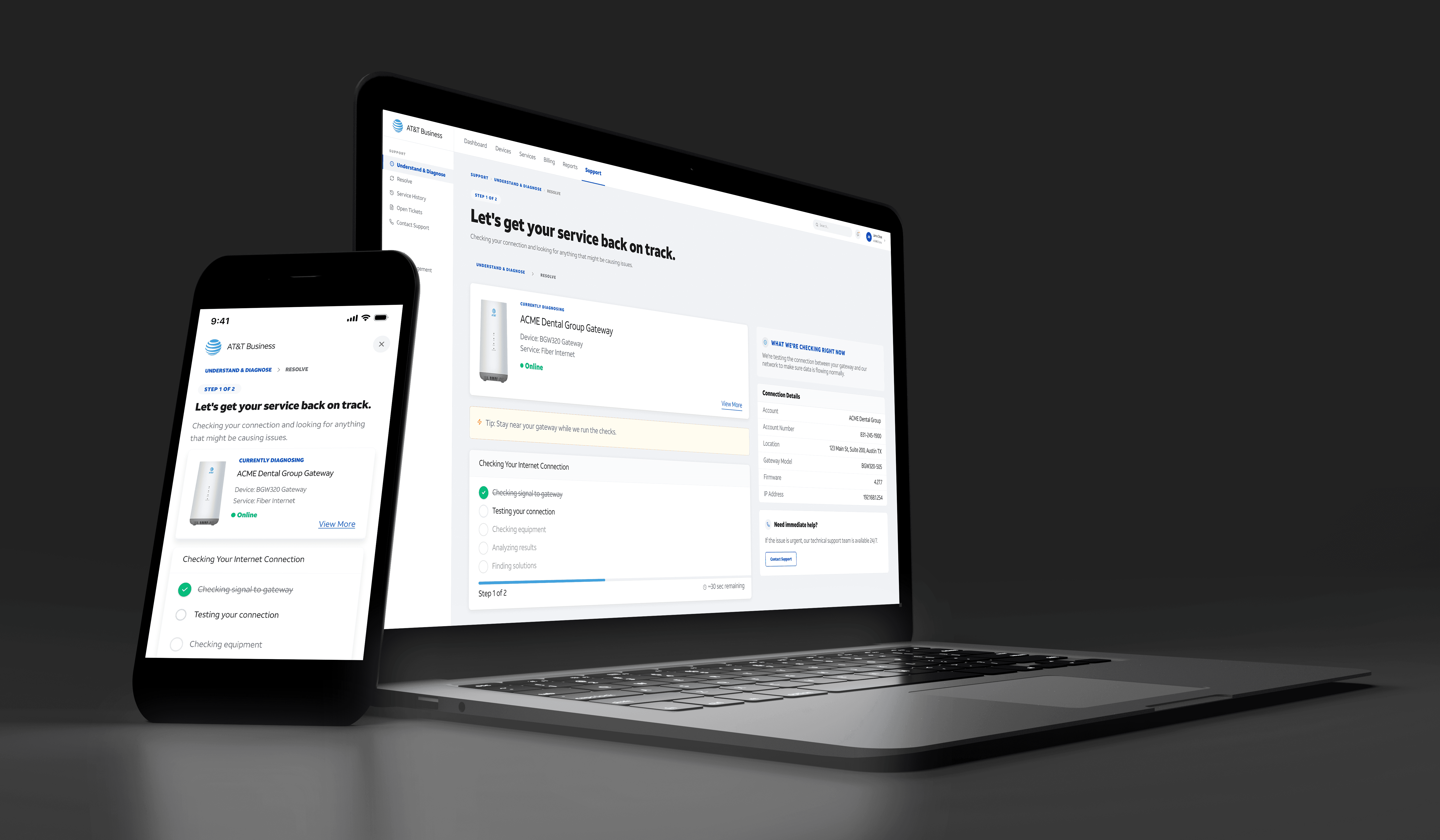
Case Study 01
SaaS UX
B2B
AT&T Business - AI Incident Management
Rebuilding trust in AI-assisted self-service support during AT&T Business's ServiceNow transformation.
text
X min.
X min.
X min.
X min.
X min.

Case Study 01
Agentic AI
Fashion Tech
Styllo - Agentic Wardrobe Assistant
Designing an AI-native personal styling platform that optimizes for better wardrobe decisions, not bigger shopping carts.
text
X min.
X min.
X min.
X min.
X min.
Case Study 01
Design Systems
Enterprise UX
Pizza Hut - Store Management System
Building the store operational system that enabled 6,800+ Pizza Hut restaurants to transition from a legacy platform to a modern operational ecosystem.
text
Next Project
X min.
X min.
X min.
X min.
X min.
Case Study 01
CRO
A/B Testing
Pizza Hut - Deals Page Optimization
Redesigned Pizza Hut's deals page to improve promotion discovery, deal comprehension, and increase conversion.
text
X min.
X min.
X min.
X min.
X min.
Case Study 01
SaaS UX
B2B
AT&T Business - AI Incident Management
Rebuilding trust in AI-assisted self-service support during AT&T Business's ServiceNow transformation.
text
X min.
X min.
X min.
X min.
X min.
Case Study 01
Agentic AI
Fashion Tech
Styllo - Agentic Wardrobe Assistant
Designing an AI-native personal styling platform that optimizes for better wardrobe decisions, not bigger shopping carts.
text
X min.
X min.
X min.
X min.
X min.
Case Study 01
Design Systems
Enterprise UX
Pizza Hut - Store Management System
Building the store operational system that enabled 6,800+ Pizza Hut restaurants to transition from a legacy platform to a modern operational ecosystem.
text
Next Project
X min.
X min.
X min.
X min.
X min.
Case Study 01
CRO
A/B Testing
Pizza Hut - Deals Page Optimization
Redesigned Pizza Hut's deals page to improve promotion discovery, deal comprehension, and increase conversion.
text
X min.
X min.
X min.
X min.
X min.
Case Study 01
SaaS UX
B2B
AT&T Business - AI Incident Management
Rebuilding trust in AI-assisted self-service support during AT&T Business's ServiceNow transformation.
text
X min.
X min.
X min.
X min.
X min.
Case Study 01
Agentic AI
Fashion Tech
Styllo - Agentic Wardrobe Assistant
Designing an AI-native personal styling platform that optimizes for better wardrobe decisions, not bigger shopping carts.
text
X min.
X min.
X min.
X min.
X min.
Case Study 01
Design Systems
Enterprise UX
Pizza Hut - Store Management System
Building the store operational system that enabled 6,800+ Pizza Hut restaurants to transition from a legacy platform to a modern operational ecosystem.
text
Next Project
X min.
X min.
X min.
X min.
X min.
Case Study 01
CRO
A/B Testing
Pizza Hut - Deals Page Optimization
Redesigned Pizza Hut's deals page to improve promotion discovery, deal comprehension, and increase conversion.
text
X min.
X min.
X min.
X min.
X min.
Case Study 01
SaaS UX
B2B
AT&T Business - AI Incident Management
Rebuilding trust in AI-assisted self-service support during AT&T Business's ServiceNow transformation.
text
X min.
X min.
X min.
X min.
X min.
Case Study 01
Agentic AI
Fashion Tech
Styllo - Agentic Wardrobe Assistant
Designing an AI-native personal styling platform that optimizes for better wardrobe decisions, not bigger shopping carts.
text
X min.
X min.
X min.
X min.
X min.
Case Study 01
Design Systems
Enterprise UX
Pizza Hut - Store Management System
Building the store operational system that enabled 6,800+ Pizza Hut restaurants to transition from a legacy platform to a modern operational ecosystem.
text